


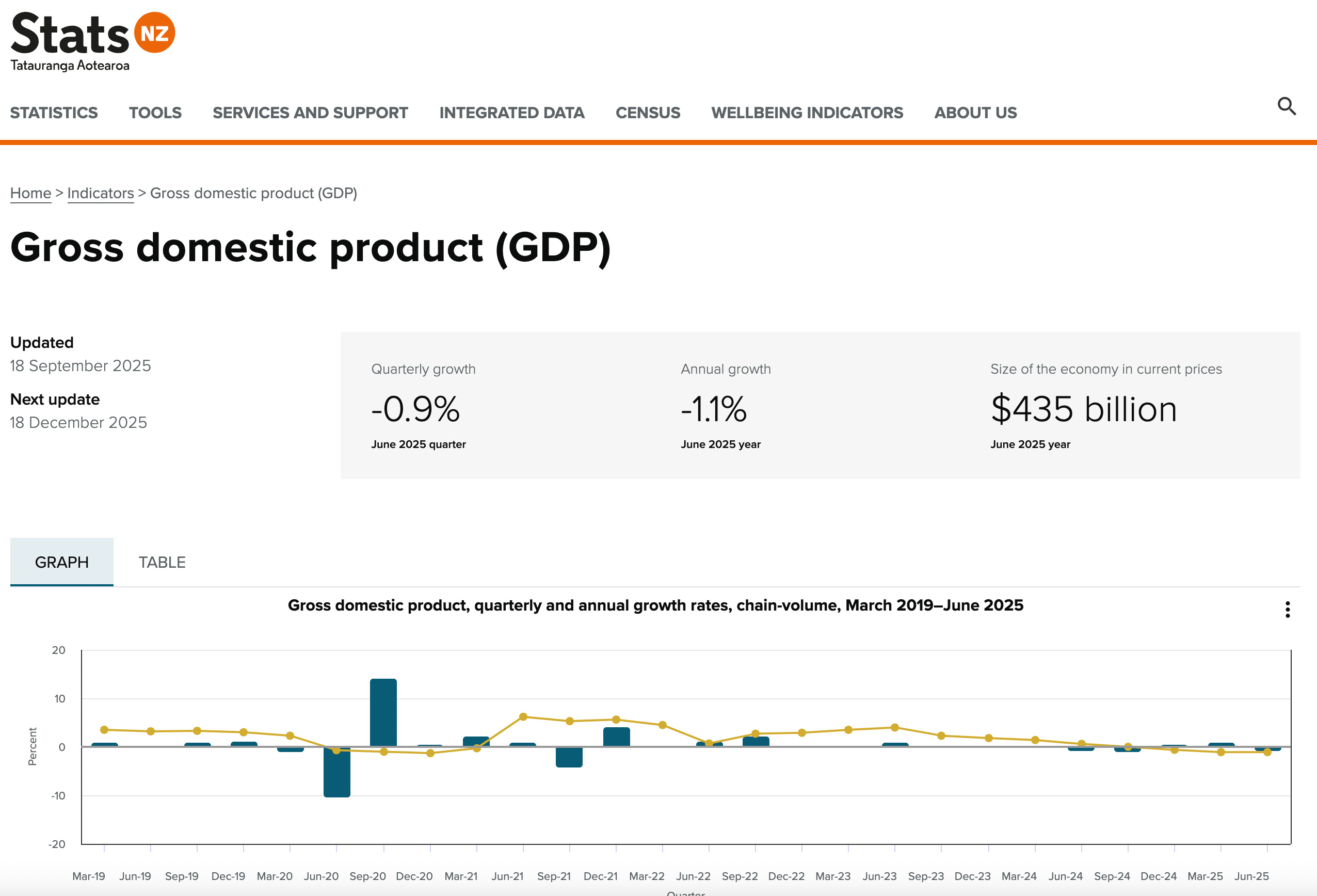
Last week Stats NZ revealed that GDP growth in the June quarter was –0.9 percent. In plain English: the country produced less of the stuff that people need and want, meaning a lower standard of living – and less money flowing into the government’s bank account.
That was a body blow for the Luxon government. But does it mean they’re “dog tucker” in the next election?
Luxon’s main promise in the 2023 election campaign was to “grow the economy”. The negative June figure arrived in the midst of his first (and only?) term in office, revealing that his government is not delivering on that pledge. Moreover, to blame the previous government is no longer credible.
Neither was it credible, however, for the previous prime minister, Chris Hipkins, to insist that Luxon & Co should resign as a whole. That was just standard opposition rhetoric. Hipkins didn’t specify when the government should resign (did he mean asap?), and he excused his own party for not having yet finalised alternative policies, and hence not even being ready for a snap election. In any case, things weren’t going all that well when Hipkins was running the show.
No resignation will (on its own) help to grow the economy. It won’t help tradies, retail workers or labourers to find more or better jobs. Calling for resignations is empty rhetoric, suggesting that one hasn’t a clue what to do.
The Opposition may be “unready” for an election, then, but the Government isn’t winning either. To add to Luxon’s economic woes, he’s getting net-negative approval ratings, his National Party is behind Labour in most recent polls, and about a half of Kiwis are telling surveyors that the country’s heading in the wrong direction.
An underlying problem is an unrealistic pledge to “grow the economy”: a promise that no one can promise to keep, as we’re seeing. To put it another way, there’s a shared illusion that political leaders and parties can actually “manage the economy”, and hence that it’s just a matter of voters picking the party that does the best job of it. Of recent prime ministers, John Key was the most adept at maintaining that illusion.
New Zealanders look to governments for their economic success, and they’re quick to blame them when things don’t go well. That saves us from the difficult task of thinking about doing better for ourselves. Mirroring that, political leaders compete over who’s the best “economic manager”, and polling companies chime in by asking non-experts for their reckons on which party they trust most on economic management. This is theatrical: it lacks any substance regarding real-world economic activity.
If governments don’t literally “grow” economies, then what important roles do they play? Here’s a basic list:
Manage the country’s single biggest budget, including tax policies.
Create a regulatory environment that gives producers and consumers confidence (e.g., that you won’t get food poisoning from products in the supermarket).
Invest in education.
Be a backstop for people when things go wrong, by providing health and welfare services – which also helps to keep people spending.
Negotiate and maintain trade agreements with other economies.
If a government fails in those basic tasks, the economy suffers to some degree. But “the economy” is not defined by what ministers of finance do or don’t do. “The economy” is an abstract term we use to talk about the countless productive activities and exchanges that all of us are doing in real time, not all of which depend on public services. Indeed, the largest, most important percentage of it is not performed by agencies of government at all (except in a communist command economy). Many argue that governments should stay out of their way altogether.
On the other hand, a strict austerity approach – making budget surpluses the primary aim – just perpetuates a downward spiral by reducing consumer demand and draining resources from education and health.
That éminence grise of the 1980s, Sir Roger Douglas, resurfaced last week to call (pointlessly) for the finance minister to resign, accusing her of doing nothing about the rising costs of pay-as-you-go healthcare and pension programmes, and hence massive unfunded liabilities. (Hear him interviewed on The Platform.) A savings-based welfare system is the way to go, he said. New Zealand already has some elements of this: fully-funded ACC, Kiwisaver and the NZ Super Fund (the “Cullen fund”) that partially pre-funds pensions – so don’t write his idea off altogether, even though Sir Roger didn’t convince Michael Laws.
Could the presently fully-funded ACC scheme be extended to cover all health and disability care, for instance? It’s not a new idea, but it’s a huge job to undertake a transition from pay-as-you-go to full funding. When this has been mooted in the past, people have yelled “unaffordable!” and that’s been the end of the debate.
Or is the (supposedly independent) Reserve Bank to blame? There’s been plenty of argument over whether the RBNZ’s monetary policy was too stimulatory for too long around 2020/21, leading them to take aggressive steps in late 2022 to slow down spending and “deliberately engineer” a recession. Now the argument’s about whether rate cuts are coming too slowly, even though the Bank accepts that the recovery “stalled” – if it ever really got started. (The OCR is currently at 3 percent, down from 5.5 percent a year ago, while inflation was 2.7 percent in the year to June, within the target band.) As always, the banking experts had differing views ahead of the last rate cut – but it was largely over how much to cut it, not whether to do so. The latest negative growth figure makes another rate cut look more likely. Finance minister Nicola Willis reassures home-owners that lower interest rates will boost their disposable incomes.
For Politics Happens, however, the main question is how much damage is being done to National’s chances of returning to office next year now that their main election pledge (“grow the economy”) is failing to materialise.
The depletion of political capital for “brand Luxon” in undoubtedly serious – but the election is still a year away.
Luxon and Willis will be hoping and praying for that elusive recovery in the new year. But the Opposition have yet to come up with a credible alternative policy platform, especially Labour’s long-awaited tax policy.
For some time now, I’ve been writing about New Zealand’s economic woes and about the possibility that Luxon could be a one-term wonder. If you’re a new reader and want to review what I’ve said so far, here are some recent posts:


I took a bit of a break from attending to comments from free subscribers, but I’ve opened that up again, and look forward to hearing your considered opinions.
I will return to the topic of “Leading Democracies” soon. But I feel compelled to weigh in again on political opinion polls.
Thanks for a concise reality check . I can do no better than quote James Thurber " “Politics is the art of looking for trouble, finding it everywhere, diagnosing it incorrectly, and applying the wrong remedies.”
Thanks for this piece Grant, restacked.
Its frustrating the lack of awareness around the government's function with the economy and how widespread the perception is that politicians are "managers". That phrase they should be "running the country" does my head in lol.