


On Friday the United States invited New Zealand and others to join an international operation to reopen the Strait of Hormuz. Wellington will consider the matter. There are some important conditions that still need to be clarified as New Zealanders weigh this up. It’s not as straightforward as it may sound.
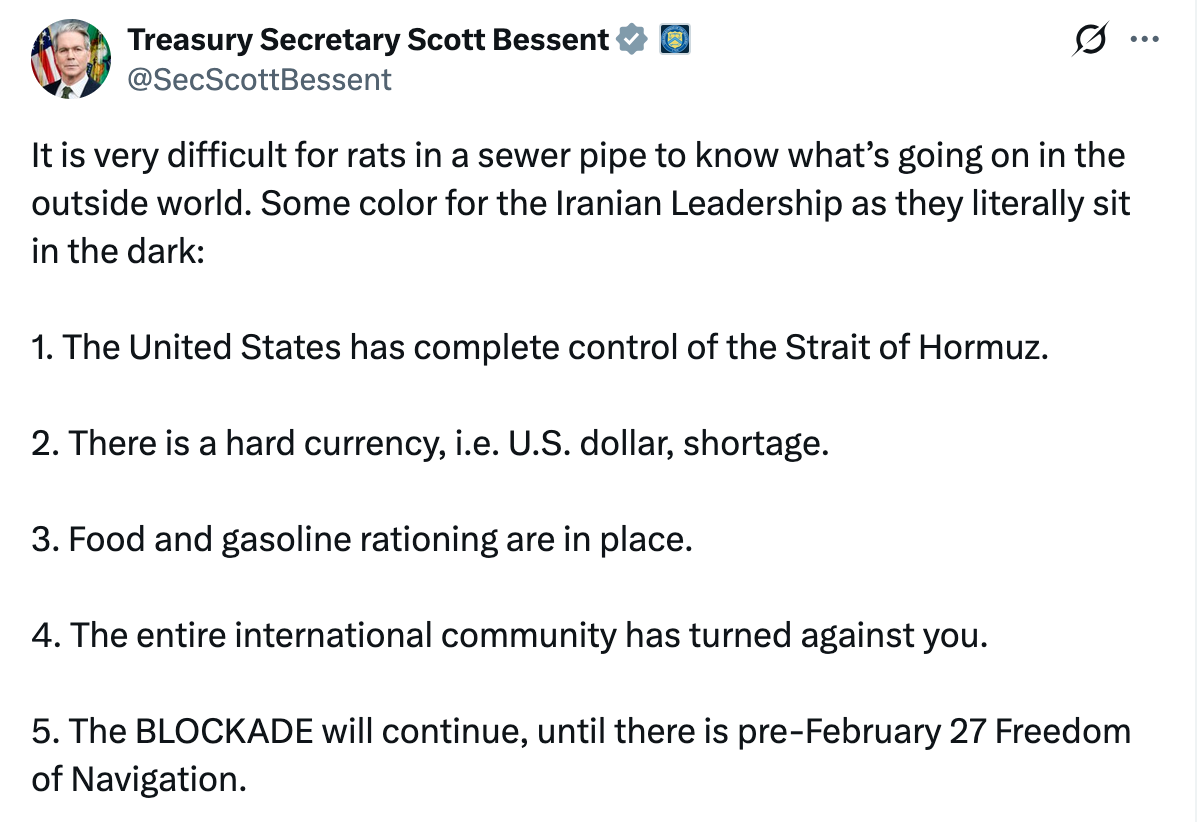
US policy is puzzling. Treasury Secretary Scott Bessent posted recently on X, “The BLOCKADE will continue, until there is pre-February 27 Freedom of Navigation”. So it’ll continue until it stops, it seems, or “beatings will continue until discipline is restored”. Or did he mean that the American blockade on Iranian shipping will continue until the Iranian blockade on non-Iranian shipping ends? Or, the Americans will use force to open the Strait, and only then will navigation be free?
Who knows what they mean? This is the trouble with an administration that seems to make up policy on social media, while at the same time dehumanising the people with whom they ought to be negotiating. Bessent described the Iranian leaders as “rats in a sewer pipe”. (That kind of language is below par as far as Politics Happens is concerned but isn’t unusual from the Trump administration.)
The Iranian government’s recent proposal to end the war, according to NPR, includes guarantees against future military aggression, the withdrawal of US forces from Iran’s periphery, an end to the naval blockade, the release of frozen Iranian assets, payment of reparations, the lifting of sanctions, an end to fighting in Lebanon, and a new mechanism governing the Strait of Hormuz.
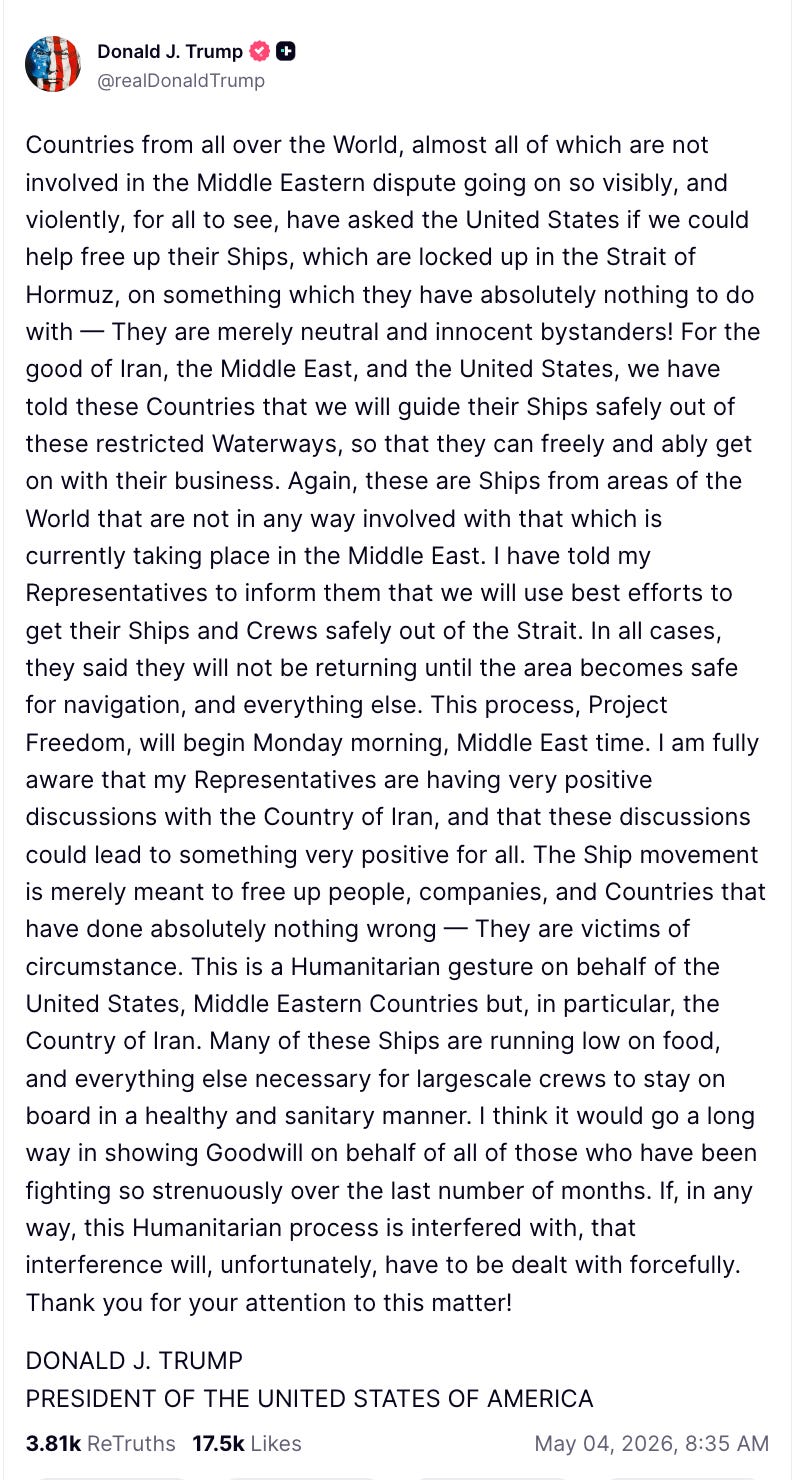
The proposed US mission to reopen the Strait would appear to be only a selective reopening, presumably with naval escort. They reportedly want to maintain the blockade on ships serving Iran – in the absence of a full peace treaty. So a US-led international taskforce would not be welcomed by the Iranian government. What, then, if the ceasefire broke down and Iran attacked warships? Could a RNZN frigate find itself exchanging fire with the IRGC?
Most New Zealanders would welcome a full peace agreement and a resumption of normal shipping. But I’d imagine that most Kiwis would also disapprove of the theocratic regime in power in Tehran, as it violates human rights, especially women’s rights, and is guilty of murdering thousands. But genuine regime change isn’t happening there – so far. And it doesn’t sound like the US is proposing a peacekeeping mission at this time. It looks more like a continuation of economic warfare, the effects of which, including hyper-inflation and loss of jobs, are suffered by the people of Iran, hitting those who don’t even support the regime. There’s a lot to weigh up.
I discussed this and related matters with Wallace Chapman and The Panel on RNZ on Friday evening.
The NZ government’s statement of 1 March concerning the US–Israeli attack on Iran did not express support. It only went as far as to “acknowledge that the actions taken by the US and Israel were designed to prevent Iran from continuing to threaten international peace and security”.
But material support for an operation to ensure safe passage through a critical sea-lane is another question, and it affects NZ’s economic interests. Do Kiwis want to be in on this or not? Should NZ support the Americans as a long-term ally, or should NZ beg to differ with them on this occasion as their critical friend? Or should NZ condemn the American–Israeli intervention and play no part in it? – regardless of the price of petrol and diesel.
This decision is a defining one for Luxon’s coalition government, and it could become a hot issue in election debates.
Any NZ contribution to a US-led mission would be militarily insignificant, but morally and politically meaningful. And this sensitive matter follows controversy within the coalition government.
Last week, the NZ First Party let it slip that prime minister Christopher Luxon had initially pushed to express support for (and not just to “acknowledge”) the US–Israeli attack on Iran. Explicit support would have been in line with Australia and Canada who’d copied and pasted wording that looked like it had been drafted in the US State Department.
Peters was making it known that he was the one who’d restrained the NZ government to a position that “neither condemns nor gives explicit support to the US action” and only acknowledged one part of the justification that President Trump had offered. This release of emails between ministers’ offices had apparently breached the Cabinet Manual guideline about confidentiality and breached the no-surprises clause of the coalition agreement. Give Winston some guardrails and he’ll bend them!
Nonetheless, we are given to believe that Winston had the decisive role in shaping the NZ government’s statement on the attack, and furthermore that Winston was more in tune with majority public opinion (although many people wanted them to go much further and to condemn the attack outright).
According to an IPSOS poll, “81% on average across 31 countries think their country should avoid getting involved in the current conflict in the Middle East.” 87% in New Zealand, 85% in Australia, and 71% in the US wanted to stay out of it. Accordingly, across the 31 countries, 71% disagreed with the statement “Paying more for fuel and gas because of the current conflict in the Middle East is worthwhile”. 75% in New Zealand, 73% in Australia and 68% in the US disagreed.
Although most people around the world don’t want to get involved in this conflict, it’s in almost everyone’s economic interests to see a resumption of free commercial shipping through the Strait of Hormuz. The IPSOS poll didn’t ask people about their country’s participation in a US-led operation to reopen the Strait.
What do you think?
Provided that a ceasefire holds, that mines can be cleared and that there are strict rules of engagement, people may support participation in an operation to allow safe passage. Under present circumstances, however, there’s a risk that a ceasefire won’t hold. Iran has stated it’s prepared for further exchanges of fire.
Lloyd’s List reports over 150 non-sanctioned crude oil and product tankers stranded in the Gulf, including 62 very large crude carriers.
Update 9.25 am: President Trump has announced a naval escort for those vessels trapped in the Strait. The Iranian parliament plans to pass a law to authorise control over the Strait, including banning vessels of hostile nations.
Hormuz in History
Many readers wouldn’t have heard of the Strait of Hormuz until a few weeks ago, but it’s now in the headlines daily and everyone gets the connection between this 30km-wide gateway to the Persian Gulf and the price of gas. Hard facts of physical geography still matter to us in this age of virtual realities.
The Strait of Hormuz has been strategically important since the dawn of history. The Ancients Podcast rose to the occasion by interviewing two archeologists to give us insight into the trade routes and the material culture of the Persian Gulf in the Bronze Age. It’s fascinating to hear about the importance of Bahrain in those times.
There’s been a port at Bandar Abbas since ancient times, and, to its south-east, there’s Hormuz Island. Nearchus, an officer in Alexander the Great’s forces, led a naval expedition from the Indus along the coast and into the Persian Gulf in 324 BCE. The Parthians took over from the Greeks in the mid-third century BCE. The area came under Sassanian rule from the mid-third century CE and then fell to the Arabs in 650 CE.
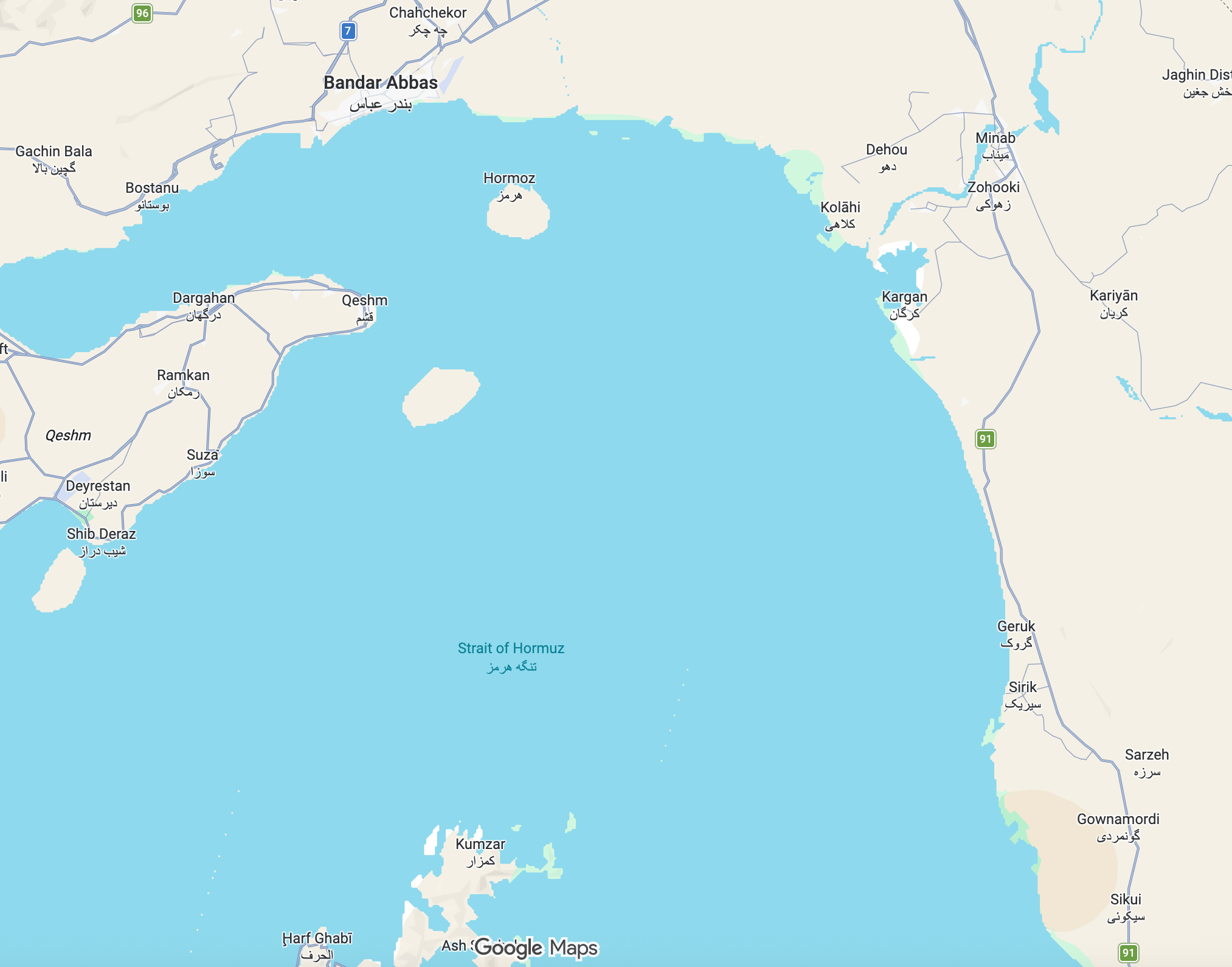
From the 10th century, a mainland town of Hormuz, near modern-day Minab, was the seat of a dynasty of Arab origin who were tributaries, at different times, of Seljuk, Turkoman and Mongol overlords in Iran. This Kingdom of Hormuz once extended as far as Bahrain and controlled both sides of the Strait.
Although it’s arid and hot, the island of Hormuz developed as a transit site for imports and exports as it had the advantage of isolation, protecting it from attacks, especially from the Mongols. Apparently people deliberately flooded the floors of homes to keep cool.
In 1293 a flotilla of fourteen Chinese sailing ships arrived in Hormuz after a two-year voyage from Quanzhou. Sent by the Mongol Yuan emperor of China, Khubilai Khan, its mission was to deliver the princess Kökečin to Tabriz (in today’s north-west Iran) as a bride for Khubilai’s great-nephew, the Il-khan Arghun. Both rulers were descendants of Genghis Khan. As it happens, Marco Polo had hitched a ride with the princess’s entourage for his return journey to Venice. Unfortunately, on arrival in Iran, they learned that Arghun had died before their voyage had even set off. The Il-khanate had been taken over by Arghun’s brother, but Khubilai decided that Kökečin should instead be married to Ghazan, Arghun’s son. Ghazan seized the throne in 1295. Kökečin, often known as the Blue Princess, died in 1296. (For the full story, see Brooks, 2019).
The Ming treasure voyages under Admiral Zheng He in the early 15th century went as far as Hormuz and into the Persian Gulf.
Visitors to the market-town of Hormuz described it as a busy emporium with traders from all over the Persian world and from as far afield as Russia, Abyssinia, India and China. It had a reputation for wealth and decadence. As Fiorani puts it:
“Hormuz was long a great maritime dominion whose magnificent capital city rose on a rocky island, the island of Jarun, located at the entrance of the Gulf, at the crucial strategic Strait of Hormuz… [The Kingdom of Hormuz] was a vast liquid space, a positive mobile, international, cosmopolitan society.”
The 16th century saw the rise of the Safavid dynasty in Persia. Their big struggles were on land with the Ottomans to the west and the Turkic Uzbeks in the east. As they weren’t great sea powers, neither the Hormuzans nor the Safavids could prevent a Portuguese fleet under Alfonso de Albuquerque from assaulting Hormuz Island in 1507. Although he initially faced a mutiny as well as local resistance, Albuquerque built the Fort of Our Lady of the Conception on the island, once Hormuz had capitulated in 1515. This was part of the Portuguese effort to establish and monopolise maritime trade routes, along with Goa and Malacca, and not an assault on the Safavid Empire itself.
The ensuing Treaty preserved the Hormuzan Crown’s sovereignty over its people and its religious affairs. The Kingdom of Hormuz had levied tolls on commercial traffic through the Strait, and the Portuguese took over that very lucrative revenue. Meanwhile, the Portuguese and the Safavids managed pragmatically to reduce conflict in the Persian Gulf as they had a common enemy: the Ottomans.
In 1622, however, the Safavid Shah Abbas did a deal with the English East India Company who supplied warships to bombard Portuguese forts on the islands of Queshm and Hormuz. The Portuguese were expelled from Hormuz, but not from the Persian Gulf altogether. The English gained access to the Persian silk trade.
Later on, the English would worry (probably unnecessarily) about the Persian Gulf being used as a route for a Russian or French attack on their possessions in India. (Hopkirk, 1994).
The Anglo-Persian Oil Company (a precursor of BP) was formed in 1909 and began large-scale production at a refinery in Abadan, close to the top of the Gulf. The Company cut a deal to supply the Royal Navy which was converting its fleet from coal to oil. Consequently, the Persian Gulf and Mesopotamia were of vital interest to the British in World War I. The British withdrew in 1971.
The Strait of Hormuz has always been strategically important, but this has obviously risen with the oil industry. In 1978 two thirds of world oil supplies (as compared with one fifth recently) were passing through it, according to Ramazani, and hence the Strait of Hormuz “should be considered as the world’s single most important strait economically because it is marked by a vital global interest and the passage of goods, services, resources, and technology, with oil shipments the heart of its economic importance”. That was published in 1979, the year that the Islamic Republic of Iran was born from a revolution.
During the Iran–Iraq War (1980–88), American naval vessels were in the Gulf, ostensibly for purposes of freedom of navigation. Iran Air Flight 655, a scheduled passenger flight from Tehran to Dubai via Bandar Abbas, was shot down on 3 July 1988 by two surface-to-air missiles from the guided-missile cruiser USS Vincennes. All 290 people on board were killed. The Vincennes had been in Iranian territorial waters close to the Strait at that time, and the plane may have been misidentified as an Iranian F-14 fighter. It’s controversial to this day.
Now that the Iranian government and the IRGC have used Hormuz as an economic weapon, they’ll be unwilling to surrender it, even if they’re contravening international maritime law. Global economic sabotage and extortion work better for them than any nuke, it seems. The Israeli/US attack on Iran has left the world in a worse situation than it needed to be, then, largely due to the strangulation of a narrow maritime corridor.
It would have been better to have stuck to the JCPOA (Joint Comprehensive Plan of Action) signed in Vienna in 2015 between China, France, Germany, Russia, the UK, the US and the Islamic Republic of Iran. Trump pulled out of that agreement during his first term in the White House, insisting that it was the worst deal ever done. Will he come up with a better deal now?
This brief history is just a sketch of some key moments, compiled by a non-expert. If you have a historical note or nuance to add, please do so in comments.
References
Axworthy, Michael, 2010. A History of Iran. Basic Books.
Baer, Marc David, 2021. The Ottomans. Basic Books.
Brooks, Timothy, 2019. Great State: China and the World. Profile Boks.
Fiorani, V. P. 2018. “The Gulf: A Cosmopolitan Mobile Society – Hormuz, 1475–1515 CE”. In A. J. Fromherz (Ed.), The Gulf in World History: Arabian, Persian and Global Connections (pp. 35–56). Edinburgh University Press. http://www.jstor.org/stable/10.3366/j.ctv7n0bqg.9
Floor, Willem M. “Hormuz ii. Islamic Period.” Encyclopaedia Iranica. Published December 15, 2004. https://www.iranicaonline.org/articles/hormuz-ii/
Hopkirk, Peter, 1994. The Great Game. US: Kodansha.
Melville, Charles. “Boloğān Ḵātūn”. Encyclopaedia Iranica. Published December 15, 1989. https://www.iranicaonline.org/articles/bologan-katun-the-name-of-three-of-the-royal-wives-of-the-mongol-il-khans-in-iran/
Ramazani, R.K. 1979. International Straits of the World: The Persian Gulf and the Strait of Hormuz. Netherlands: Sijthoff & Noordhoff.
Rogan, Eugene, 2015. The Fall of the Ottomans. Penguin.
Tazmini, G. 2017. “The Persian–Portuguese Encounter in Hormuz: Orientalism Reconsidered”. Iranian Studies, 50(2), 271–292. http://www.jstor.org/stable/26157164
Uzi Rabi, 2006. “Britain’s ‘Special Position’ in the Gulf: Its Origins, Dynamics and Legacy”. Middle Eastern Studies, 42(3), 351–364. http://www.jstor.org/stable/4284458
I haven’t got my hands on what looks to be the best English-language source:
Floor, Willem M. 2006. The Persian Gulf: a political and economic history of five port cities 1500 - 1730. Washington, DC: Mage Publishers.
Um … is there some other alternative country we could support militarily? I’m not keen on any of these options (Israel, the US, Iran). They all seem to be run by warmongers who regularly break international law. All three commit or are direct enablers of genocidal acts. I was moved by your story of the Chinese princess, who got a younger husband than was originally arranged, but then died 2 years later - sad.
If we join the US/Israel in opening the straits, then we are surely supporting their illegal war against Iran. It shouldn't even be a matter of debate, if we really care about and support the rule of law et al