

Western Civilisation: Part 2
Who's defending it? Who's attacking it? What is it anyway?

If you missed Part 1, it’s here.
The term “Western Civilisation” sits within the present-day political-economic antagonism as a straw person.
Western Civilisation has been described in historical, cultural and philosophical terms. A standard narrative hops boldly from ancient Athens, to Rome, to Latin Christendom (skipping Greek and Russian Orthodox), to the Italian Renaissance, to the Reformation, to the Enlightenment and then to the modern era of scientific progress, global expansion, representative government and all the good things that go with them – such as pain-free dentistry. The geographical focus shifts westwards from the Greek and Italian peninsulas in the Mediterranean to Atlantic-facing Western Europe and Britain, and across the ocean to America, and then further afield to provincial outposts in Australasia etc.
The gets mixed up with a geopolitical notion of “the West”, often meaning more or less the US, its NATO and Five-Eyes allies and some like-minded hangers-on. The phrase “we in the West” gets tossed out blithely without any thought as to who’s encompassed within that “we” – let alone asking whether “we” even know who one another are.
Western Civilisation has been retro-fitted into History. Plato never thought of himself as a Western philosopher. The notion would have made no sense to him. Aristotle’s famous pupil Alexander the Great conquered Persia, to the east. What lay to their west, other than some Greek colonies dotted around the Mediterranean, was less civilised, if not barbaric, and hence of no interest to them.
Or think of Niccolò Machiavelli who wrote historical accounts of Florence and Rome. He’d be utterly dumbfounded to learn that The Prince is now widely read in many languages, given that he wrote it just for one person and never sent it to the printer. The very ideas of a “Renaissance” (or Rebirth), during which he is said to have lived, and a “Western Civilisation”, didn’t exist in his time. Both were explanatory devices invented and developed from the mid-nineteenth century onwards. Machiavelli could not have aspired to become a key figure in (then non-existent) “Western” political philosophy or “Renaissance” literature. The big geopolitical contest in his time was between the Papacy in Rome and the Holy Roman Empire, with the French and Spanish monarchies involved too – Christians fighting one another.
This doesn’t mean that the historical-civilisational construct of Western Civilisation has no value at all. It’s just to suggest cautious use, as it was invented relatively recently for the purpose of understanding the past – and for warning about what may be coming. Oswald Spengler’s Decline of the West was first published in two volumes in the aftermath of World War I and it struck a chord with the pessimism of those times. It’s therefore interesting to ask why “Western Civilisation” has again become a Thing that’s in decline, or at risk of erasure, and now in need of defence – and defence against what or whom? Who’s attacking it?
The present-day problem boils down to international competition and internal dissent.
Let’s look at the internal dissent first. In nominally “Western” universities, it’s common to hear the term “Western” used (and over-used) with negative connotations, drawing attention to colonisation, world wars, racism and slavery and to neglect of “non-Western” traditions ranging from Ayurvedic medicine to Zoroastrianism as compared with “Western” sciences and culture.
There are historical facts to support that kind of critique of “the West”. This requires a capacity for critical self-reflection, however, which some argue is a special strength of Western thinking. But self-criticism can reach perverse levels:
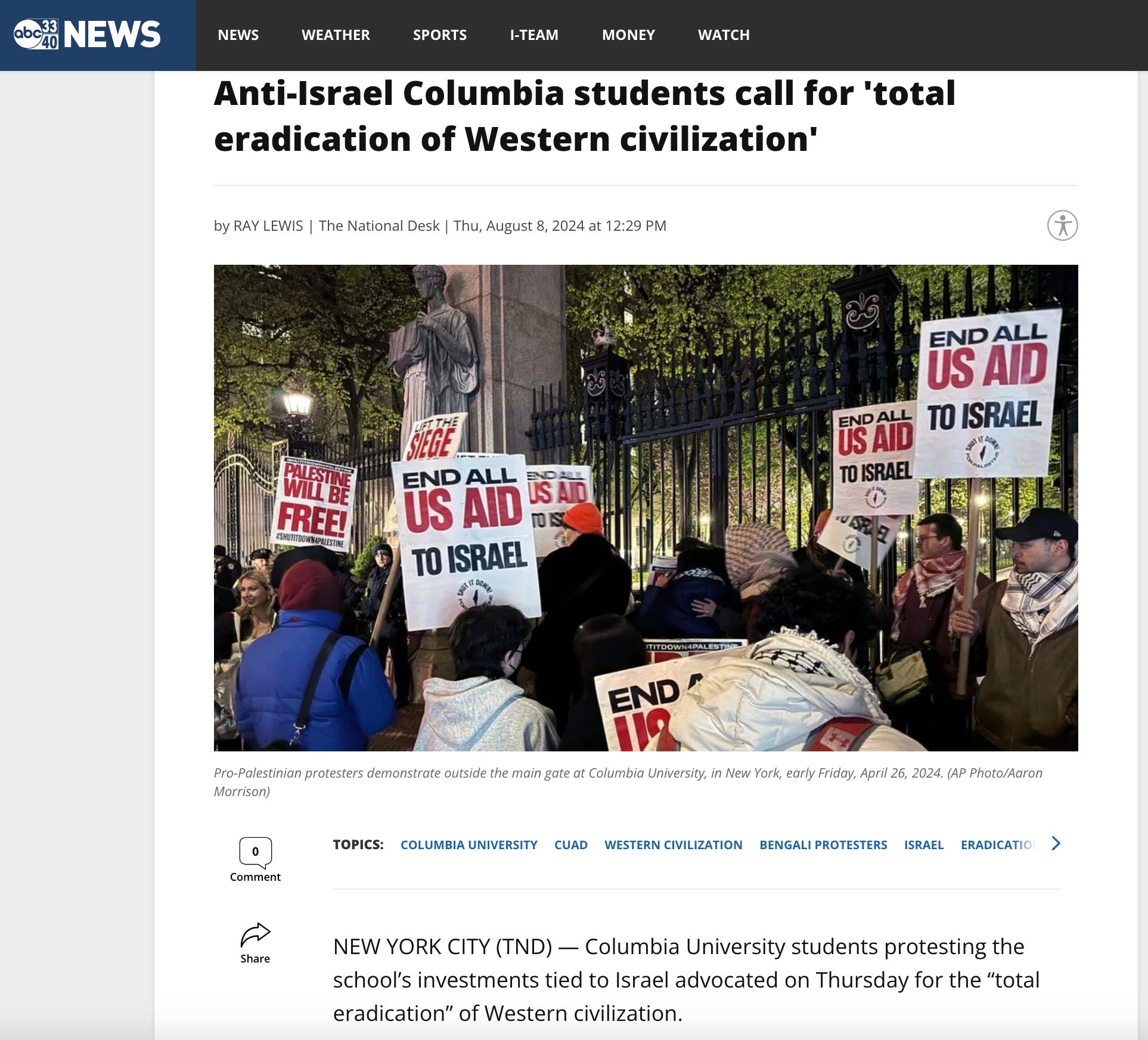
A few brats who made it into Columbia University are on a mission to eradicate the very traditions of learning that gave them that privilege.
Any reading of the histories of those civilisations that are ostensibly “non-Western”, however, will also uncover records of ruling classes suppressing those below them, when they’re not threatening and killing one another, or wiping out traditions that they didn’t like. Some people, then, might reject any notion of civilisation at all, as it does have a normative meaning, which can imply superiority over those deemed primitive or barbaric.
If civilisation entails people living in large urbanised, stratified societies with complex cultural traditions, with moral and legal codes that help them to live well together, and with long-distance trade, then civilisation itself, Western or otherwise, is both problematic and beneficial. There’s a glass-half-empty and a glass-half-full view.
James C. Scott in Against the Grain argues that the gradual shift in ancient times towards living in cities was not good for humans overall. After all, why did humans take so long to make the change, and why, for many centuries, did so many prefer to be nomads? But then Amanda Podany in Weavers, Scribes, and Kings: A New History of the Ancient Near East provides evidence that life in the earliest cities wasn’t all that bad, even for the underlings. Both books are highly recommended.
An urban-centered society must have some benefits, or people wouldn’t have opted for it. The Germanic barbarians, for instance, didn’t want to destroy Roman civilisation: they wanted a share of it, and they got it. Perhaps they were tired of living on horseback. Along the way, many converted voluntarily to the Arian version of Christianity that had been ruled out at the Council of Nicaea in 325 CE.
That brings me to the external threats. A key text is Huntington’s Clash of Civilizations (1996), which asked whether world politics would be dominated by conflicts between civilisations. Huntington did another historical retro-fit and made up a classification of the world’s civilisations that’s as crude as those old nineteenth-century divisions of Homo sapiens into “races”. He concluded:
“The West differs from other civilizations not in the way it has developed but in the distinctive character of its values and institutions. These include most notably its Christianity, pluralism, individualism, and rule of law, which made it possible for the West to invent modernity, expand throughout the world, and become the envy of other societies.”
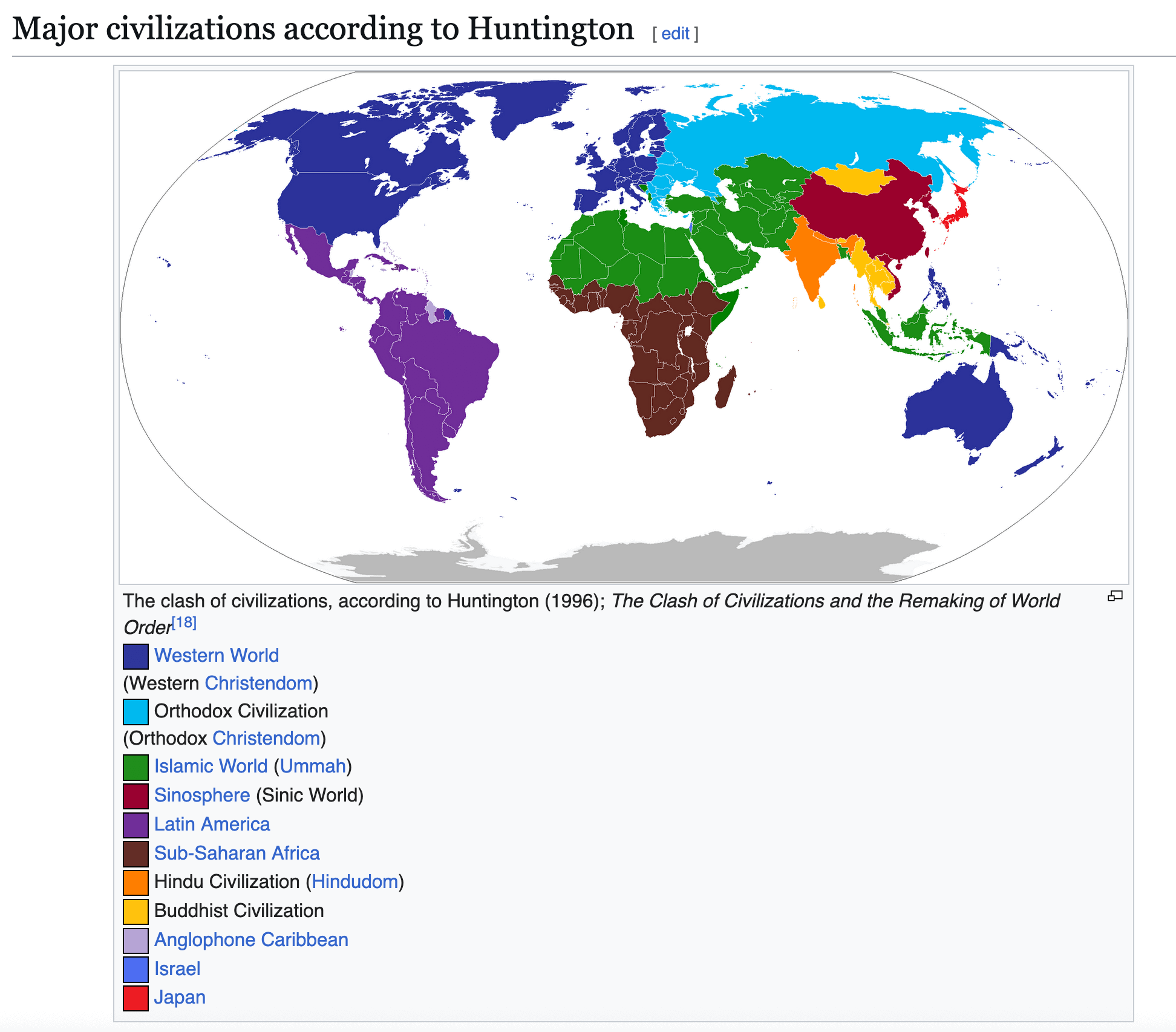
The influence of Huntington’s book outweighed its scholarly credibility, although the terrorist attacks on the US on 11 September 2001 did seem to vindicate his theory. (Since then, populist politics have undermined Huntington’s thesis, for example by undermining the rule of law and putting nationality first, even though populists also exploit civilisational tropes.) What makes reality more interesting than a “clash of civilisations”, however, is the lack of clear boundaries between civilisations. No matter how we imagine and classify them, civilisations share and trade as much as, if not more than, they “clash”. There’s some great work being done by historians to explore the nuances and complex interconnections, for example William Dalrymple’s The Golden Road, or S. Frederick Starr’s Lost Enlightenment, or Timothy Brooks’s Great State: China and the World.
If leaders from western Europe and North America appear now to be at odds with one another and are facing competition from China, India and Russia, it doesn’t mean that Western Civilisation itself, if we must adopt that construct, is at risk of collapsing. And, even if it is, there may be bigger problems to worry about anyway.
There are many great things that we inherit from the past (or our pasts) and that are worth preserving and defending, and we may identify such heritage with a particular civilisation. But dividing the world up into distinct, rival civilisations – which Putin has done, as well as Rubio and others – is not helpful for progress and peace in the world.
Gandhi defined civilisation as “that mode of conduct which points out to man the path of duty”, but even he asserted supremacy: Indian civilisation was the best and hence it had “nothing to learn from anybody else”. For instance, he wrongfully dismissed thousands of years of history in these six words: “of China nothing can be said”. He had stubbornly learned nothing from China. He had good reason to criticise British imperialism, but he wanted to tell the English, “We consider our civilization to be far superior to yours”.
Waving flags and declaring supremacy will normally lead to trouble. In my own writing I’ve avoided any references to “Western Civilisation”, but not out of disdain for the relevant traditions of learning. It’s just that these categories can obscure more than they illuminate, often causing us to overlook important cultural transfers, or, worse, generating talk about who’s superior or who’s evil.
Why, then, the anxiety about (or, for others, eager anticipation of) a collapse of Western Civilisation? Decline-and-fall stories are often compelling: things aren’t what they used to be and so, one fears, our communities and societies must be under threat. Some of those threats are real; some get exaggerated. It would be wrong to dismiss the fear of “civilisational erasure” altogether because there may be something important going on beneath it. People are genuinely experiencing economic insecurity, social change and climate change that cause them alarm and that are beyond their control; universities really have become dominated by a narrow range of supposedly “progressive” ideas and many academics do paradoxically question “free speech”. In reaction against those developments, many people, unfortunately, turn instead to populists and demagogues who preach about threats to “our civilisation” and about what “we” may have to do to defend it. The result is a polarisation of opinion, and “Western Civilisation” gets set up as a straw person to be either defended or denounced.
Let’s consider, then, one of the key figures in that great retrospectively re-imagined History of Western Civilisation: Augustine, Bishop of Hippo Regius, known posthumously as St Augustine.
As Augustine lay on his death-bed in the year 430 CE, the barbarians (the Vandals) were literally at the gates, bringing an end to Roman authority in North Africa, if not ushering in the End of Time. These nomads were Arian Christians, but they were doing some horribly un-Christian things. Rome herself had been sacked in 410 CE, and so one could have said that Roman civilisation was collapsing at that time, at least in the western side of the empire. (Constantinople, the second Rome, survived for another millennium.) To the rescue, then, comes the History of Western Civilisation, in which Augustine gets co-opted and recast as a founding father in a seamless narrative.
There are numerous columnists and lecturers who devote themselves to the defence of Western Civilisation. (Here’s a good example.) Future generations may want to retire the whole notion, but much of whatever it once stood for will still be valued. Its original sins won’t be forgotten either.
Here’s an AI-generated image of Augustine, Bishop of Hippo, North Africa. No one really knows his skin colour, as no one remarked on the matter in those times. No one would have called him a black theologian, but he was at least half Berber.
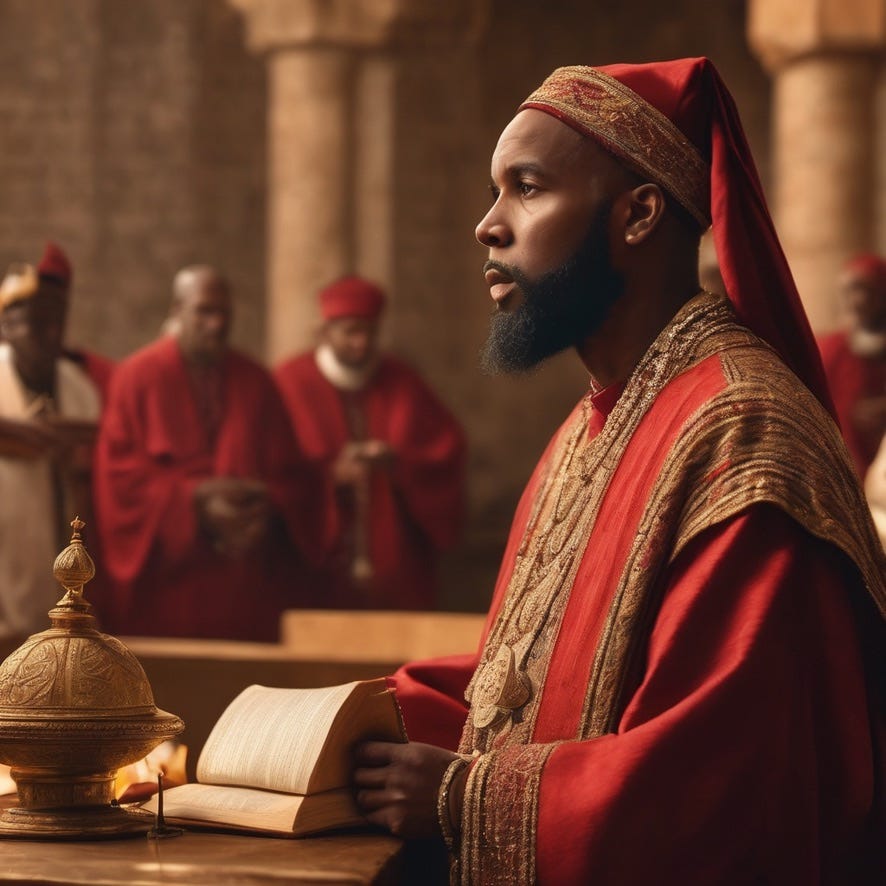
This matter perplexed the Irish author Flann O’Brien to a degree that he used that barely printable N-word.
There have also been lively debates over the appearance and skin colour of Socrates and Jesus, two other key figures in the Western Civilisation story. These questions can’t be resolved with any certainty, but that only reminds us not to conflate a colour-based racial category with all things “Western”. Someone should point this out to Elon Musk.
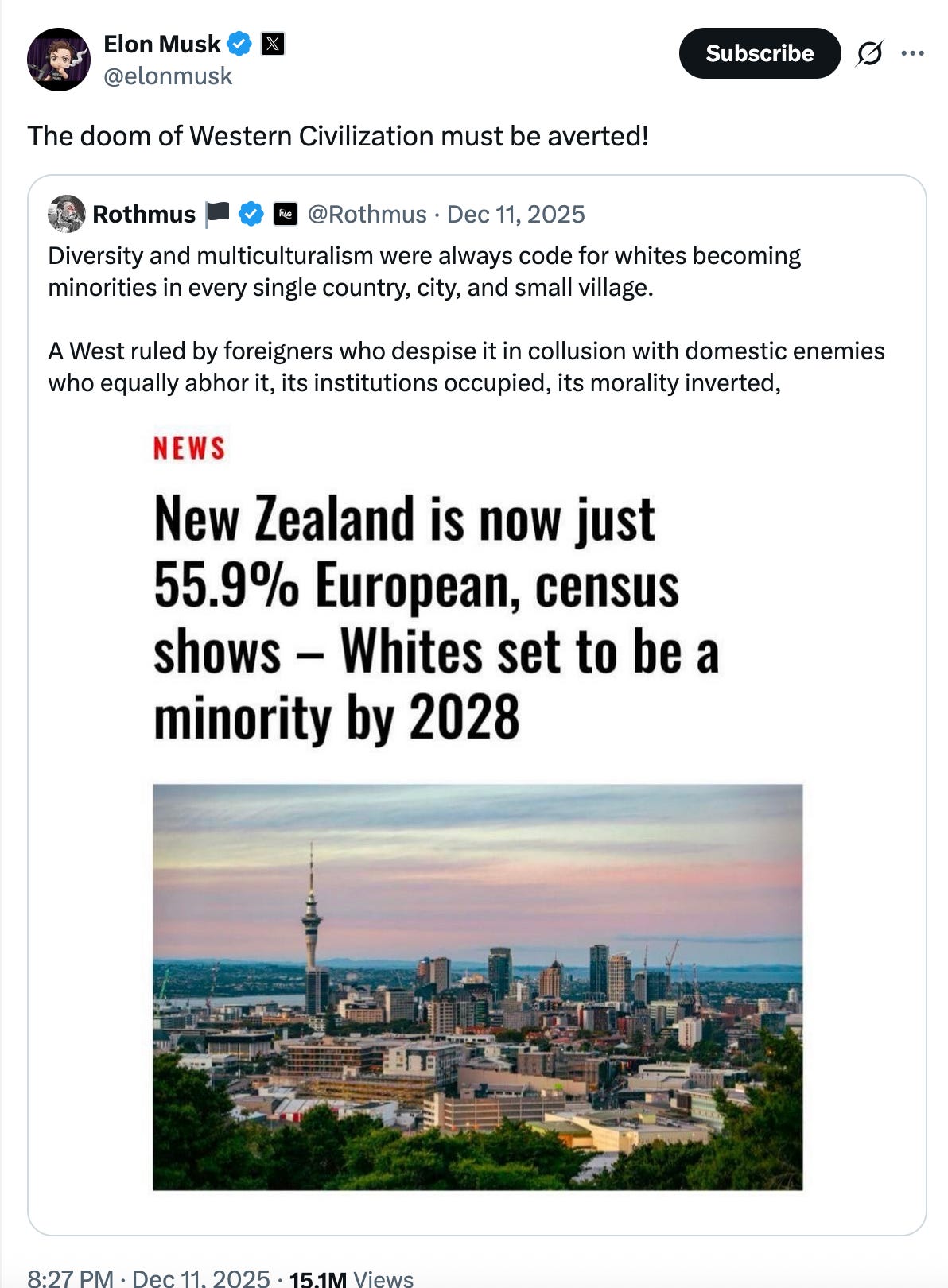
Notice the careless conflation of civilisation, country, culture and colour.
(Fact check: in 2023, Stats NZ estimated that 67.8% of people living in Aotearoa New Zealand identified with a “European” ethnicity. The category “white” isn’t used in NZ official statistics. Ticking the “New Zealand European” census box doesn’t necessarily mean “I’m fair-skinned”.)
Defence of “Western Civilisation”, in some people’s minds, including Elon Musk’s, is a proxy for their will to perpetuate white supremacy and to restrict immigration – and also to advance a post-neoliberal model of political economy.
Defenders of Western Civilisation tend also to be loud in their defence of free speech. Some insist that it should be considered acceptable to insult people and to spew hatred, as if that demonstrates how “free”, “enlightened” and “civilised” one is.
(By the way, I’m a defender of free speech. But my freedom requires respect for the freedom of others. It thrives on rational, civilised discourse and withers in the face of uncivil insults and hatred.)
Elon Musk and X are at the centre of this weird fusion of racism, anything-goes free-speech demagoguery and a grand narrative about the cultural pedigree of the West. The likelihood that Musk will become the world’s first trillionaire goes hand-in-glove, I’m afraid, with his racist rhetoric. It sits alongside a president who can warn on his own online platform that he might just destroy a whole civilisation. They’re symptoms of the world into which we are now stumbling.
Perversely, these latter-day “defenders of Western Civilisation” reject those post-War international institutions such as the UN that, as Huntington and others pointed out, were “shaped according to Western interests, values and practices”. They fear the emergence of “one world government”, and they push their own versions of minimalist, networked crypto-states in which they can rule.
Free speech is a basic human right. What the Musks and Trumps of this world actually believe in is The Best Free Speech Money Can Buy - a la Fox News or CBS News under the Ellisons and infamously ruled in favour by the Citizens United vs FEC case - which is no less detrimental to actual free speech than state censorship of the Putinist & North Korean kind. On a personal level, TBFSMCB thinks it's entitled to throwing the N-word, F-word (the one that rhymes with 'maggot', not 'duck), R-word (rhymes with 'leotard', not 'bassist), K-word, and other violently loaded slurs. Done organisationally, it usually takes the form of scapegoating vulnerable groups that don't have the resources to defend themselves - pre-WW2 eugenics campaigns and Der Sturmer come to mind.
https://www.sej.org/publications/watchdog/why-media-consolidation-threatens-press-freedom-democracy
https://truthout.org/articles/media-monopolies-and-prosecution-of-assange-drive-drop-in-us-press-freedom-rank/
https://asiapacificreport.nz/2025/05/04/new-deal-for-journalism-rsfs-11-steps-to-reconstruct-global-media/
And if there really is a "cultural Marxist" 5th column in Western universities, it's doing a $#!t job of it. Speaking of your mentions of the Roman Empire, it was already in decline by the time the Goths finally sacked it in 476 - years of corruption, military overreach, decadence and greed (and possibly also lead poisoning) were big contributing factors.
The one thing capable of destroying America right now isn't from outside its borders, but from within. Here's a hint: it's descended from an ideology that claimed to be about defending "states' rights", and caused the deaths of more Americans than all other wars involving America.